
When a food wholesaler decides to replace its ERP and WMS, attention naturally focuses on the new features: inventory management, order picking, mobility, and dashboards.
However, experience shows that an ERP project does not succeed because of the software alone. It succeeds because of the quality of the data migration.
Replacing an ERP Is Not Just Copying a Database
After years of operation, an information system contains far more than data—it also reflects established work habits, exceptions, duplicate records, and sometimes inconsistencies that have accumulated over time.
A successful migration involves analyzing, validating, transforming, and improving the reliability of this information before integrating it into the new environment. Without this step, the new ERP simply inherits the problems of the old one.
Some Data Leaves No Room for Error
In the food wholesale industry, certain information must be migrated with absolute accuracy.
For example:
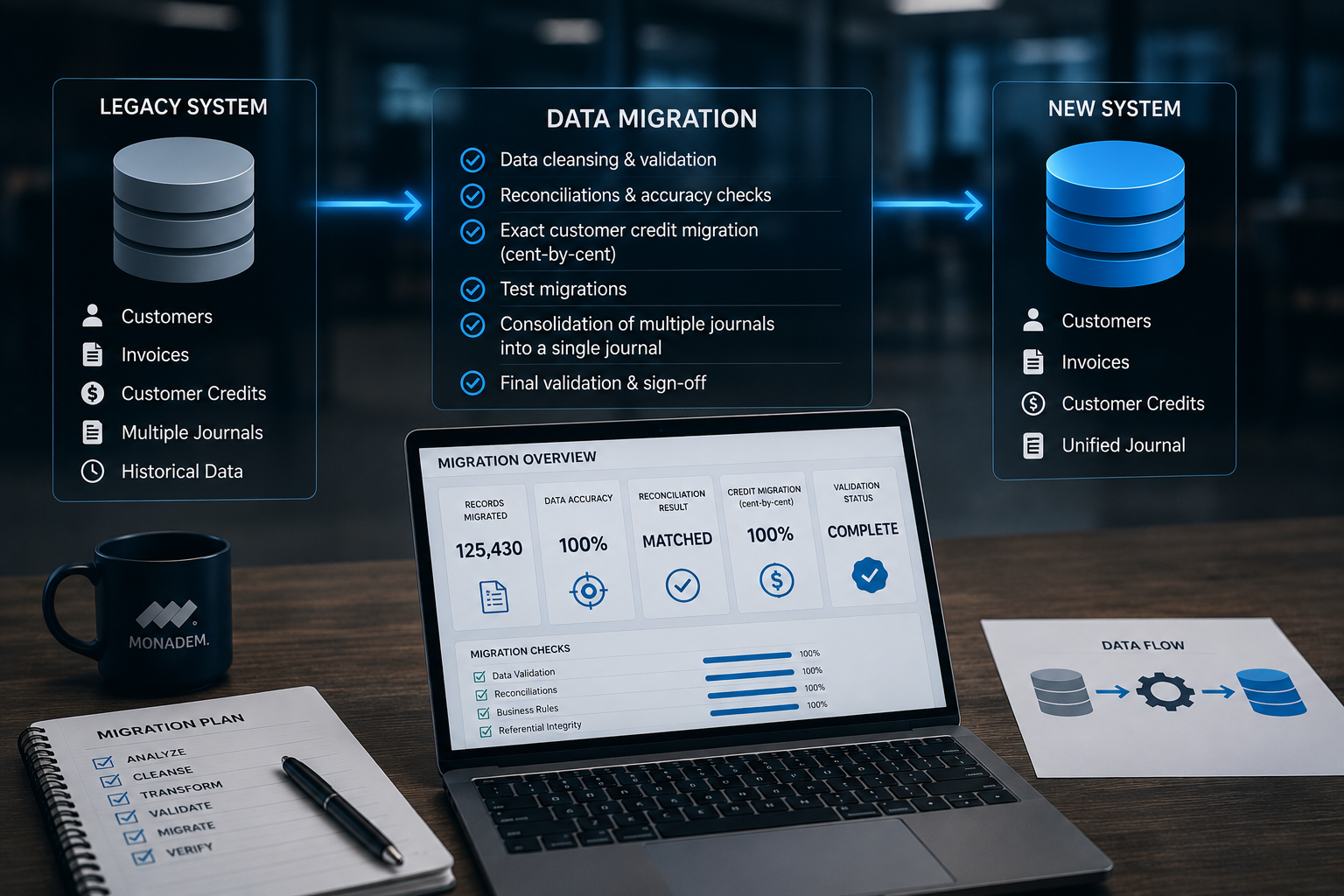
- Customer records and their history
- Invoices and accounting documents
- Customer credit balances and outstanding amounts down to the last cent
- Historical data required for traceability
- Consolidation of multiple accounting journals into a simpler, more consistent structure
Even the smallest discrepancy can result in accounting differences, invoicing issues, or hours of manual verification after the system goes live.
Migration Is Also an Opportunity to Clean Up Your System
An ERP replacement is often the only opportunity a company has to start with a truly clean database.
Removing duplicate records, standardizing master data, correcting inconsistencies, verifying balances, and validating historical records all contribute to the long-term reliability of the new system. This work is rarely visible, but it determines the quality of every operation that follows.
What Sets a Well-Managed Migration Apart
A successful migration is much more than moving data from one system to another. It relies on a rigorous methodology: analyzing the existing system, cleaning the database, defining transformation rules, reconciling accounting data, performing automated validations, running test migrations, and obtaining approval from business users before go-live.
On launch day, users should find their customers, invoices, inventory, and account balances exactly as they left them—only now supported by a more powerful ERP.
ERP Success Begins Long Before Go-Live
Choosing an ERP is a strategic decision. But what truly distinguishes a smooth implementation from a costly one is the ability to manage the data migration effectively.
Because the best data migration is the one users never talk about… simply because everything works perfectly from day one.